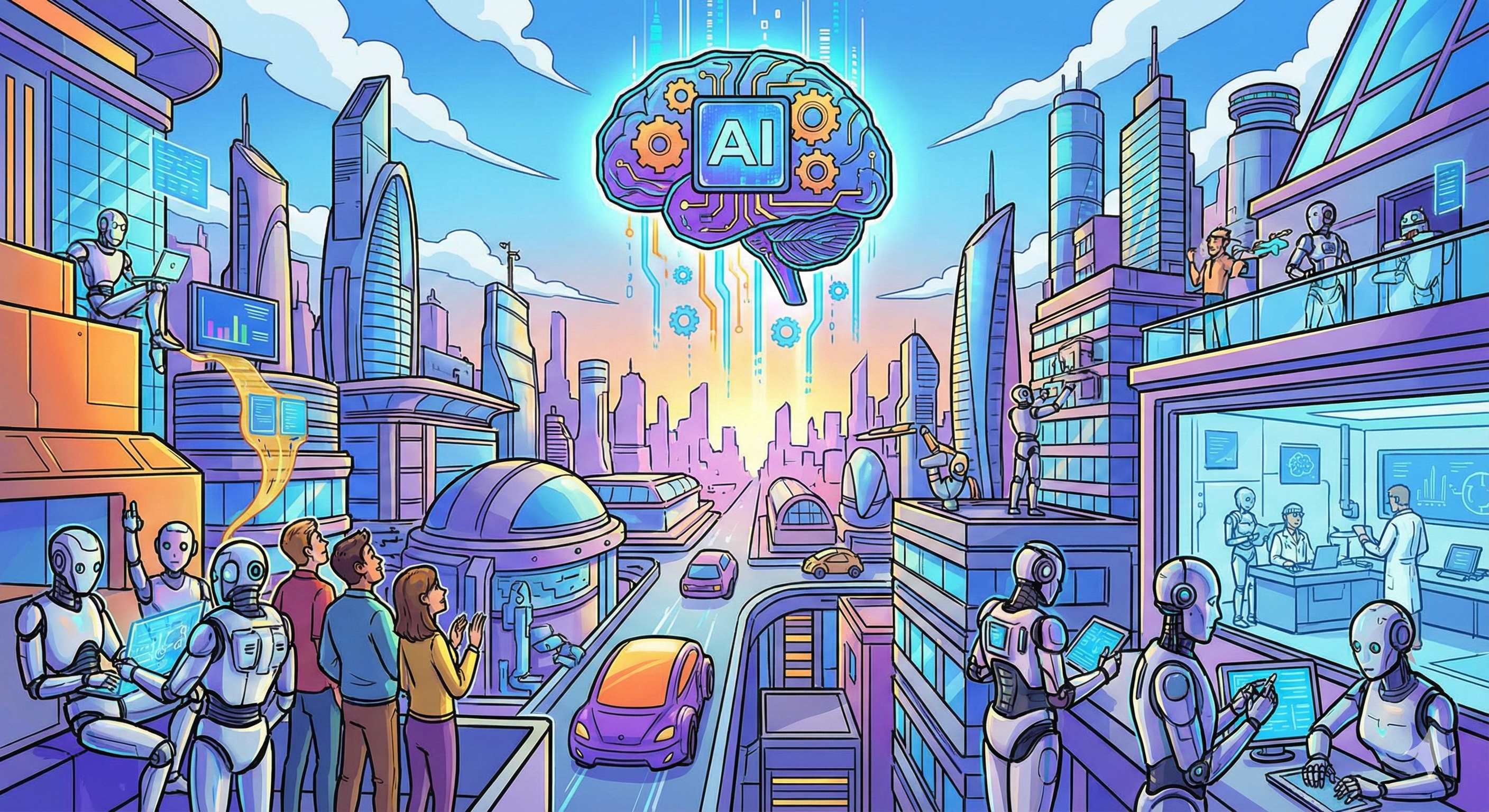
The Rise of Autonomous Agents: How 2026 Is Redefining AI Capabilities
Imagine a world where AI doesn’t just assist—it acts. Where digital entities make decisions, execute tasks, and adapt without human intervention. This isn’t science fiction; it’s the reality of autonomous agents in 2026. As artificial intelligence evolves, these self-governing systems are reshaping industries, workflows, and even daily life. But what exactly are autonomous agents, and how are they redefining AI capabilities? Let’s dive into the transformative trends, breakthroughs, and implications of this AI revolution.
What Are Autonomous Agents?
Autonomous agents are AI-driven systems capable of performing tasks independently, learning from their environment, and making decisions without constant human oversight. Unlike traditional AI tools that rely on predefined rules or prompts, these agents operate with a degree of self-sufficiency, leveraging advanced technologies like:
- Machine Learning (ML) – Enables agents to improve through experience.
- Natural Language Processing (NLP) – Allows seamless human-AI interaction.
- Reinforcement Learning – Helps agents optimize actions based on rewards and penalties.
- Computer Vision – Empowers agents to interpret and respond to visual data.
The Evolution of Autonomous Agents by 2026
The journey from rule-based bots to fully autonomous agents has been rapid. By 2026, several key advancements are propelling this evolution:
1. From Narrow AI to Generalized Autonomy
Early AI systems were narrow—excelling in single tasks like chatbots or recommendation engines. Today, autonomous agents are breaking these silos. In 2026, we’re seeing:
- Multi-modal agents that integrate text, voice, and visual inputs.
- Context-aware decision-making using real-time data streams.
- Cross-domain adaptability, such as an agent managing both customer service and supply chain logistics.
2. The Role of Large Language Models (LLMs)
LLMs like GPT-4 and beyond serve as the cognitive backbone of modern autonomous agents. In 2026, these models are:
- More efficient, requiring less computational power.
- Customizable for niche industries (e.g., healthcare diagnostics, legal research).
- Capable of long-term memory, retaining context across extended interactions.
3. Edge AI and Real-Time Autonomy
With the rise of edge computing, autonomous agents now process data locally on devices—reducing latency and enhancing privacy. Applications include:
- Autonomous drones for delivery and surveillance.
- Smart home systems that adapt to user habits without cloud dependency.
- Industrial robots performing complex assembly tasks in real-time.
Industries Transformed by Autonomous Agents in 2026
Autonomous agents are no longer confined to labs—they’re driving innovation across sectors. Here’s how:
Healthcare: Precision and Personalization
From diagnostic assistants to robotic surgeons, AI agents are:
- Analyzing medical imagery with superhuman accuracy.
- Managing patient records and treatment plans autonomously.
- Providing 24/7 virtual health companions for chronic disease management.
Finance: Smarter, Faster Decisions
Banks and fintech firms leverage autonomous agents for:
- Fraud detection in real-time using behavioral analytics.
- Automated trading with adaptive risk assessment.
- Personalized financial advice via AI-driven wealth managers.
Manufacturing: The Era of Self-Optimizing Factories
Industry 4.0 is here, with agents:
- Predicting equipment failures before they occur (predictive maintenance).
- Orchestrating supply chains dynamically to reduce waste.
- Collaborating with human workers as cobots (collaborative robots).
Challenges and Ethical Considerations
While the potential is vast, autonomous agents raise critical questions:
1. Bias and Fairness
AI systems can inherit biases from training data. In 2026, mitigating bias involves:
- Diverse, representative datasets.
- Transparency in decision-making (explainable AI).
- Regulatory frameworks to audit AI fairness.
2. Security and Misuse
Autonomous agents could be exploited for:
- Deepfake propaganda.
- Autonomous cyberattacks.
- Unauthorized data harvesting.
Solutions include AI governance policies and adversarial training to harden systems against abuse.
3. Job Displacement vs. Augmentation
Will autonomous agents replace jobs? The answer is nuanced:
- Routine tasks (e.g., data entry) are most at risk.
- New roles emerge in AI oversight, ethics, and maintenance.
- Human-AI collaboration becomes the norm in creative and strategic fields.
The Future: What’s Next for Autonomous Agents?
By 2030, we can expect autonomous agents to:
- Achieve human-like reasoning in complex scenarios.
- Integrate emotional intelligence for better human interactions.
- Operate in swarm intelligence networks (e.g., fleets of delivery drones coordinating in real-time).
- Become self-improving, updating their own algorithms based on new data.
Conclusion: Embracing the Autonomous Revolution
The rise of autonomous agents marks a pivotal shift in AI—from tools to partners. As 2026 unfolds, businesses and individuals must adapt to this new paradigm by:
- Investing in AI literacy and upskilling.
- Prioritizing ethical AI development.
- Exploring collaborative frameworks where humans and agents coexist productively.
The future isn’t just autonomous; it’s intelligently interdependent. Are you ready?